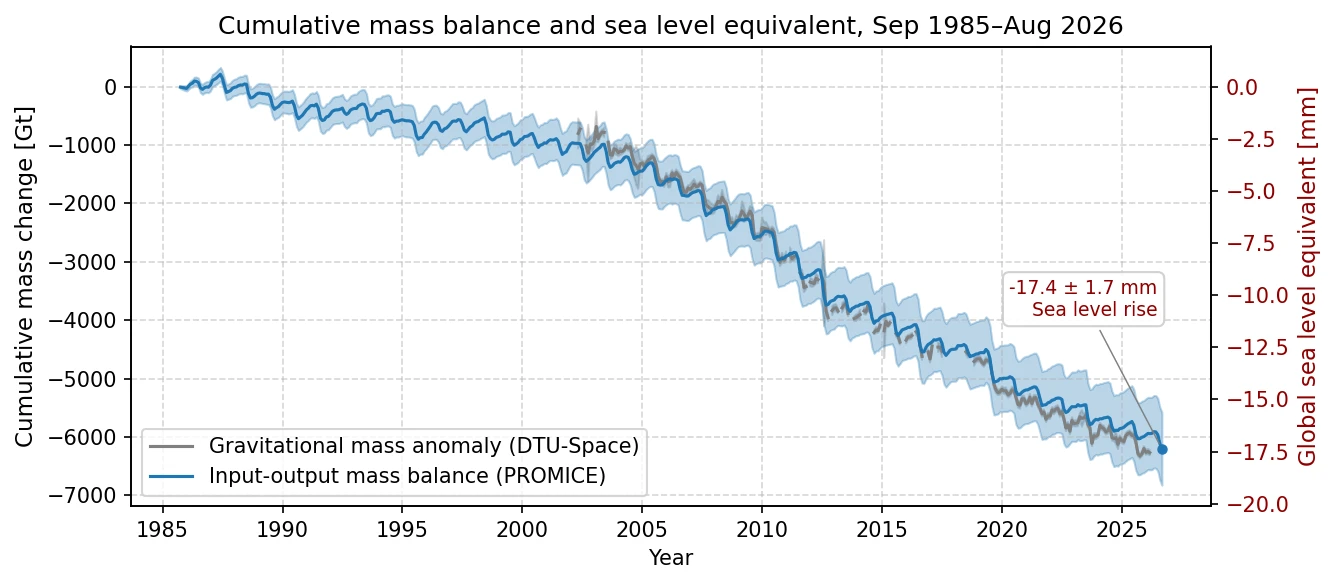
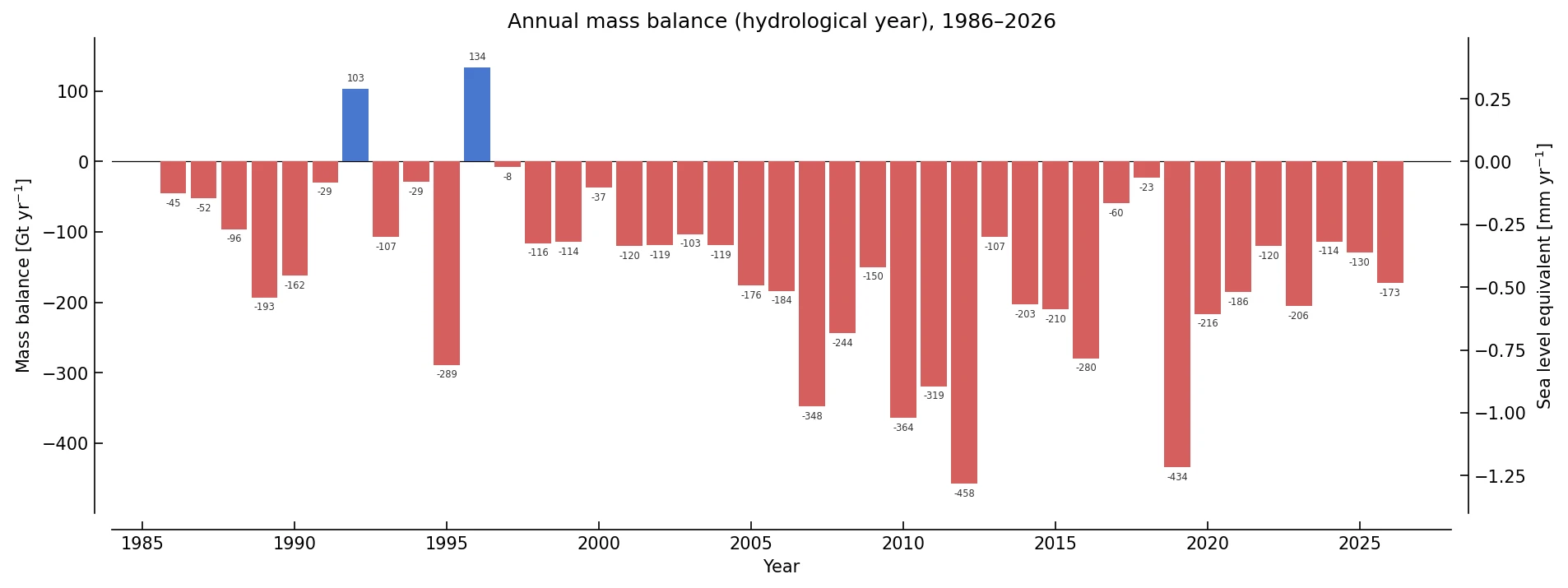
Another melting season has come to an end on the Greenland Ice Sheet, and once again the annual balance sheet shows a deficit. During the 2025/26 melting season, the Greenland Ice Sheet lost a total of approximately 173 billion tonnes of ice, according to the latest calculations from the Geological Survey of Denmark and Greenland (GEUS).
This result also marks a significant milestone, as it is now 30 years since the Greenland Ice Sheet last had a year without an overall loss of mass. Since the 1996/97 melt year, losses due to factors such as melting and iceberg calving have exceeded the accumulation of ice – particularly snow – every year.
“There are significant variations from year to year, but when we look at the trend over three decades, the picture is clear: Year after year, the Greenland Ice Sheet has been losing mass,” says Signe Hillerup Larsen, who is a researcher in the Department of Glaciology and Climate at GEUS.
Three decades of the same trend is a climate signal
The mass of the ice sheet varies naturally from year to year. The difference between two years can amount to several hundred billion tonnes of ice.
In the past, years of net loss have been followed by years of net gain, but over the last 30 years these variations have occurred within an unbroken period of negative total mass balance.
The length of this period is significant because 30 years is normally used as a reference period when scientists describe climate trends as opposed to natural year-to-year fluctuations. This unbroken sequence shows that the mass loss cannot be explained solely by individual hot summers or other short-term fluctuations. In other words, the three decades of negative total mass balance are a climate signal.
“A single year can be heavily influenced by the weather and therefore does not tell us much about long-term climate trends. That is why we researchers typically look at a 30-year period when we need to say something about the climate. The Greenland Ice Sheet has now experienced 30 consecutive years of overall shrinkage, and this strongly underlines the grim message: global warming is accelerating the melt and causing the Greenland Ice Sheet to shrink over time,” says Signe Hillerup Larsen.
A dry year with a warm end to the summer
The weather has a major impact on the surface mass balance of the Greenland Ice Sheet, which forms part of the overall mass balance. In the 2025/26 melt year, therefore, changing weather conditions left a clear mark on the figures.
“What was distinctive about this year’s weather was the stark contrasts. The ice sheet received less snow than usual throughout the winter, whilst the summer began relatively cool. From the end of July, the weather changed markedly, and the heat really set the melting process in motion,” says Martin Stendel, senior researcher at the National Centre for Climate Research at the Danish Meteorological Institute (DMI), which continuously monitors weather conditions over Greenland and, together with other data sources, contributes to the final model calculation of the Greenland Ice Sheet’s surface mass balance.
The winter and early spring were unusually dry, and as a result, around 40 billion tonnes less snow than normal accumulated on the ice sheet. The cool start to the summer, on the other hand, brought relatively frequent rainfall and more cloud cover, which reduced solar radiation and limited melting at the time of year when the sun normally contributes most to melting. By the time the warm and sunny weather set in from the end of July and continued into August, solar radiation was already waning – and so the melt was less than it would have been had the same weather occurred earlier in the summer.
Significant variations in mass loss from year to year
As mentioned, the surface mass balance is only one part of the calculation of the Greenland Ice Sheet. Ice is also lost when glaciers transport ice from the interior of the Greenland Ice Sheet towards the coast and when icebergs calve into the sea. When these various contributions are added together, researchers obtain the Greenland Ice Sheet’s total mass balance.
For the 2025/26 melt season, the total mass balance stood at around minus 173 billion tonnes. This is roughly the same order of magnitude as in 2024/25, when the mass loss was 130 billion tonnes.
However, this year’s loss was far from being among the largest in the modern record. The largest annual loss to date was recorded in 2012, when the Greenland Ice Sheet lost around 458 billion tonnes.
The large variations between years emphasise that a smaller mass loss in a single year is not necessarily a sign of a shift in the long-term trend.
“There will continue to be significant variations from year to year, and in some years the mass loss will be less than in others. But in a warmer climate, we expect the Greenland Ice Sheet to continue losing mass and thus contribute to global sea-level rise,” says Signe Hillerup Larsen.