
Can AI reveal new insights into Greenland’s mineral potential?

Published 30-10-2026

In a new research project, GEUS and the Department of Computer Science (DIKU) at the University of Copenhagen will combine geological expertise and artificial intelligence to identify previously unrecognised geological patterns and develop new methods to improve our understanding of Greenland’s mineral potential.

Seniorforsker Pierpaolo Guarnieri fra GEUS

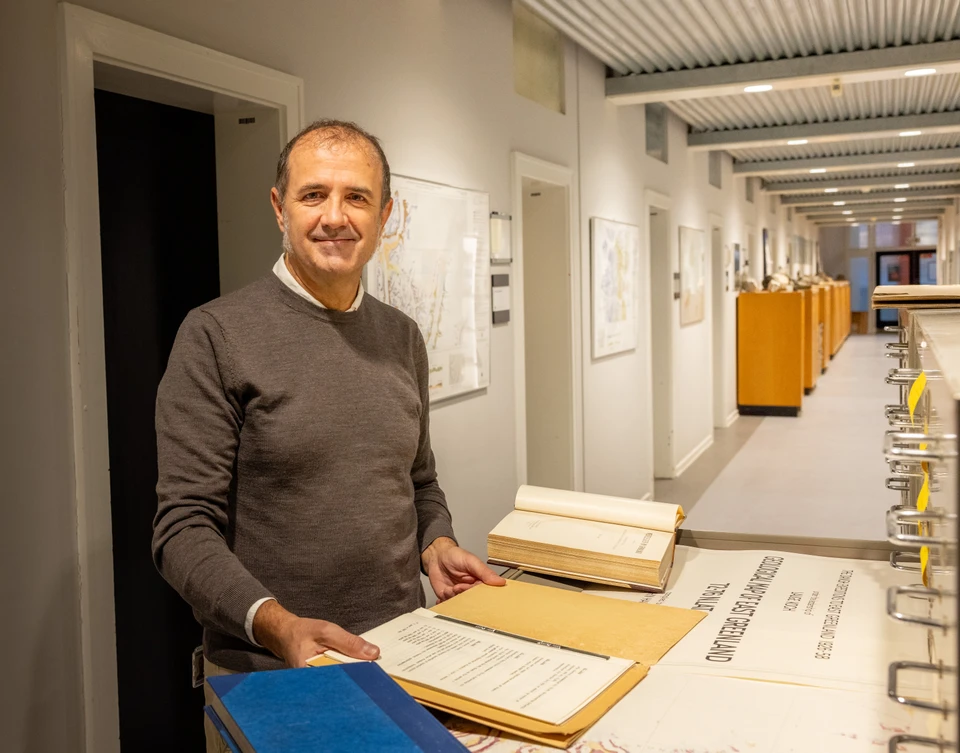
Senior Researcher Pierpaolo Guarnieri from GEUS with historical geological maps and documents from Greenland, which will now be analysed using AI.

Greenland holds significant potential for critical raw materials needed for the green transition. Identifying promising areas for mineral exploration, however, remains challenging due to the island’s vast distances, complex geology and high exploration costs.

Decades of geological investigations have generated extensive knowledge about Greenland’s geology. Much of this information is preserved in historical reports, handwritten field notes, maps and scientific databases, often in formats that are difficult to analyse together.

A new research project will now investigate how artificial intelligence (AI) can help bring these different sources together and reveal geological patterns that may previously have gone unnoticed.

The project has received DKK 4.4 million from the Villum Foundation’s Synergy programme and brings together Senior Researcher Pierpaolo Guarnieri from the Geological Survey of Denmark and Greenland (GEUS) and Associate Professor Bulat Ibragimov from the Department of Computer Science (DIKU) at the University of Copenhagen.

Unlocking decades of geological knowledge

GEUS holds extensive geological information about Greenland, collected through decades of fieldwork, mapping and scientific investigations. 

“Decades of geological reports, maps, and field observations hold a wealth of untapped knowledge about Greenland. By integrating this valuable legacy data with artificial intelligence, we aim to reveal previously unrecognised patterns and relationships, opening new routes for understanding Greenland’s geological evolution and mineral potential,” says Pierpaolo Guarnieri.

GEUS’ databases contain records of more than 600,000 geological samples, approximately 10,000 reports and over 6,000 geological maps, alongside geophysical measurements and other scientific data. The challenge is that this information exists in different formats, from structured databases to scanned historical documents containing handwritten observations, drawings and tables.
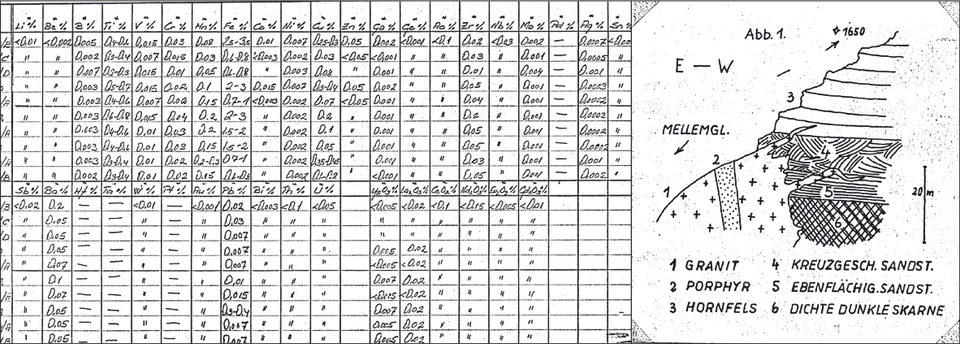
Examples of handwritten analytical data and hand drawings from historical company reports.

Combining geological expertise and AI

The project aims to address this challenge by combining GEUS’ geological expertise, databases and research infrastructure with DIKU’s expertise in artificial intelligence and machine learning.

“One of the key challenges is developing AI models that can work with geological data collected over many decades, often in very different formats and with varying levels of detail. By combining machine learning with geological expertise, we want to explore how these datasets can be used to identify meaningful patterns and make predictions that geologists can interpret and evaluate,” says Bulat Ibragimov, Associate Professor at DIKU.

The researchers will investigate whether machine learning can identify patterns in geological and geochemical data, address gaps in existing datasets and improve scientific assessments of mineral potential in areas where geological information is limited. They will also assess uncertainties in the data and predictions, including how to explain why an AI model identifies particular areas as promising.

Understanding Greenland’s mineral potential

The project will focus on selected areas of Greenland, amongst them the Franklinian Basin in North Greenland, the Nuussuaq Basin in West Greenland and the Mesozoic basin in East Greenland. The mineral resources of interest include critical and strategic raw materials.

The ambition is to develop methods that can improve the assessment of geological conditions associated with mineralisation and provide a stronger knowledge base for future research and resource assessments and for the understanding of Greenland's mineral potential.

Mineral resources in Greenland

The Government of Greenland (Naalakkersuisut) assumed responsibility for the mineral resources sector in 2010. The Greenlandic authorities are therefore responsible for its regulation and management, while GEUS contributes scientific research, geological mapping and data in collaboration with the Greenlandic authorities.

Learn more about Greenland's geology and mineral potential as well as GEUS' research in Greenland here.

About the project

Research focus: Developing an AI-based workflow for mineral exploration targeting in Greenland by combining geological knowledge, historical records and modern geoscientific data.

Research partners: Geological Survey of Denmark and Greenland (GEUS) and the Department of Computer Science (DIKU), University of Copenhagen.

Researchers: Senior Researcher Pierpaolo Guarnieri (GEUS) and Associate Professor Bulat Ibragimov (DIKU).

Funding: DKK 4.4 million from the Villum Foundation’s Synergy programme.

Duration: 2027 – 2031

Pierpaolo Guarnieri
Senior Researcher
Mapping and Mineral Resources
Press contact