
Danish biochar research forms the basis for new EU regulations

Published 23-02-2026

The first EU regulations for permanent carbon storage are now in place, and the biochar method is based on research from GEUS and Aarhus University.

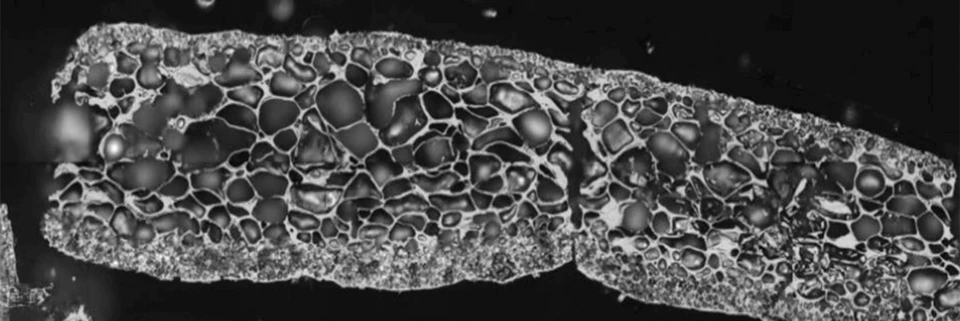
Microscopic image of inertinite – the extremely stable carbon structure that researchers use as a reference to determine when carbon in biochar can be considered permanently bound. Photo: Sanei et al., International Journal of Coal Geology (2024).

How can we document that carbon in biochar is bound stably – and for how long?

Since 2023, this question has been the focus of a research collaboration led by the Geological Survey of Denmark and Greenland (GEUS) and the Department of Geoscience at Aarhus University (AU). The result is a method that has now been incorporated into the EU’s first common standard for permanent carbon storage.

Implemented in EU regulation

On 3rd of February, the European Commission adopted the first common methods for permanent carbon storage. For biochar, the adopted method is based directly on the approach developed and published internationally by the research group from GEUS and Aarhus University.

“There has been a lack of a precise and documentable way to distinguish between stable and less stable carbon in biochar. With our method, we can quantify what can actually be considered permanent carbon storage,” says Hamed Sanei, professor at the Department of Geoscience at Aarhus University.

The EU method uses the same measurement principles, concepts and calculation models that the researchers described last year in the International Journal of Coal Geology. This means that the Danish method is now part of the EU’s official standard.

“The fact that the method is now part of EU regulations is a clear recognition of the research work. This means that there is now a common and scientifically based standard for what can count as permanent carbon storage,” says Henrik Ingermann, professor at GEUS.

The work is also part of a project that GEUS is carrying out for the Ministry of Climate, Energy and Utilities in collaboration with Aarhus University (Department of Geoscience and DCE – Danish Centre for Environment and Energy) and the Danish Technological Institute. They are developing a model for how biochar can be incorporated into Denmark’s national emissions inventory and climate projections.

What is biochar?

Biochar is produced through a process called pyrolysis, in which biological material is heated to high temperatures without oxygen. The material is considered a possible means of ‘long-term storage’ of excess carbon from the atmosphere, i.e. CO2, which is bound in the biochar. Biochar can be very stable, but not all carbon in biochar is necessarily equally resistant to decomposition.

If biochar is to be included in climate accounts and certification schemes, a method is therefore needed to document how much of the carbon is permanently bound.

New geoscientific method

Specifically, the researchers have developed a method that can quantify how much of the carbon in biocoal is so stable that it can remain in the ground for a very long time.

The core of the method is called random reflectance analysis. This involves using a microscope to measure how much light small, randomly selected biocoal particles reflect. It can be compared to shining a light on a surface. The more orderly and dense the material is, the more light is reflected back. In biochar, the measured reflection is related to how robust the carbon structure is. The more orderly the structure, the more difficult it is for nature to break it down.

By measuring many particles, the researchers obtain a comprehensive and reliable picture of how stable the biochar is.

But when is carbon stable enough to be called permanent? Here, the researchers have taken inertinite as their starting point – natural charcoal that is formed in present-day forest fires and was formed in forest fires millions of years ago and is found today in old deposits. Inertinite is known to be extremely stable and therefore serves as a kind of measurement standard.

Using this reference, the researchers have defined a so-called Inertinite Benchmark (IBRo2%). This indicates the proportion of carbon in biochar that has a reflectance value above 2 per cent – the same level as inertinite. This proportion can be considered permanently bound.

The method thus makes it possible to set a clear and scientifically based limit for when biocoal actually removes CO₂ in the long term and provides a common basis for regulation and climate accounts.

Facts

The method and basis for calculation are published in:

International Journal of Coal Geology 310: ‘Quantifying inertinite carbon in biochar’ 

The research was primarily conducted as part of the INNO-CCUS project BIOCHSTA, which is led by GEUS. The project investigates biochar using some of the same techniques used to study natural charcoal that has been lying in the ground for millions of years. This makes it possible to see how stable biochar is and how much carbon it can store over time.

The project has shown that a large proportion of the carbon in biochar is long-lasting and that it can be measured more accurately than before. The methods are now being used in the work to develop emission factors for biochar in Denmark and have just been implemented as standard in the EU.

BIOCHSTA is a partnership between GEUS, Aarhus University, DTU, several Danish pyrolysis companies and Biochar Europe.