
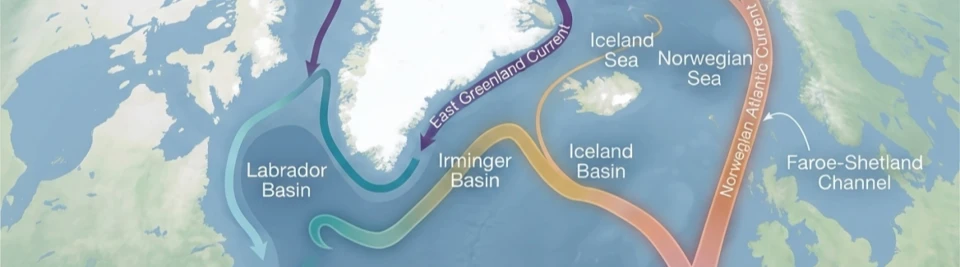
In the new research project ‘Abrupt Atlantic overturning disruptions in warm climates: empirical constraints on future risk’ (Past2Risk), Professor Camilla Snowman Andresen and colleagues will treat past interglacial periods MIS 5e (~125,000 years ago) and MIS 11 (~400,000 years ago), as natural experiments.
The Atlantic Meridional Overturning Circulation (AMOC) redistributes heat across the globe and sustains the relatively mild climate of Northwest Europe but there are uncertainties regarding the effect that the melting of the Greenland Ice Sheet has on the AMOC. MIS 5e and MIS 11 are relevant, because there were documented AMOC disruptions during these periods.
The aim of Past2Risk is to ground model evaluation in geological evidence and thus enable scientists to better evaluate AMOC risks in the coming decades.
“Ocean sediments from MIS 5e and MIS 11 allow us to investigate the full chain of events during former warm periods: from melting of the Greenland Ice Sheet, through changes in the AMOC, to the resulting climate impacts in Scandinavia. We will use the geological evidence to develop realistic scenarios of Greenland meltwater input and test how the AMOC responds to them in climate models. We can then evaluate the models against independent geological records of changes in ocean circulation and climate. This will help us understand how sensitive the AMOC is to increasing meltwater input and what different responses could mean for our future climate,” says Professor Camilla Snowman Andresen.
The project will set up various scenarios of Greenland meltwater input, reconstruct deepwater overflow strength near the Faroe Islands, and downstream climate impacts in Scandinavia.
“We are in in the fortunate situation that exceptional thick sequences up to 50 meters of shelf sea sediments were deposited in Denmark during these two highly interesting periods, allowing us reconstruct sea surface temperature and hydroclimate at very high temporal resolution,” says Camilla Snowman Andresen.
Part of the scope is to test whether major AMOC changes were preceded by early-warning signals, or whether substantial weakening can occur without clear statistical precursors.
The project runs for six years and is done in collaboration with Niels Bohr Institute at University of Copenhagen.
