
The thermal springs are home to very special ecosystems, ranging from small oases of moss and plants to springs where the water is more than 60 degrees Celsius. These environments support everything from heat-loving microorganisms to rare plants, which in Greenland are found exclusively in these springs. At the same time, the springs have cultural and economic significance, with potential for geothermal energy, growing interest from tourism and resources such as helium.
New study sheds light on Greenland’s thermal springs
Published 16-04-2026Greenland is home to hundreds of thermal springs along its ice-free coasts. In South Greenland, for example, you can bathe in water at 38–40 degrees Celsius at Uunartoq, whilst springs on the east coast can reach temperatures of over 60 degrees Celsius, where only microorganisms can survive. Now, a new scientific article brings together knowledge about these thermal springs for the first time.
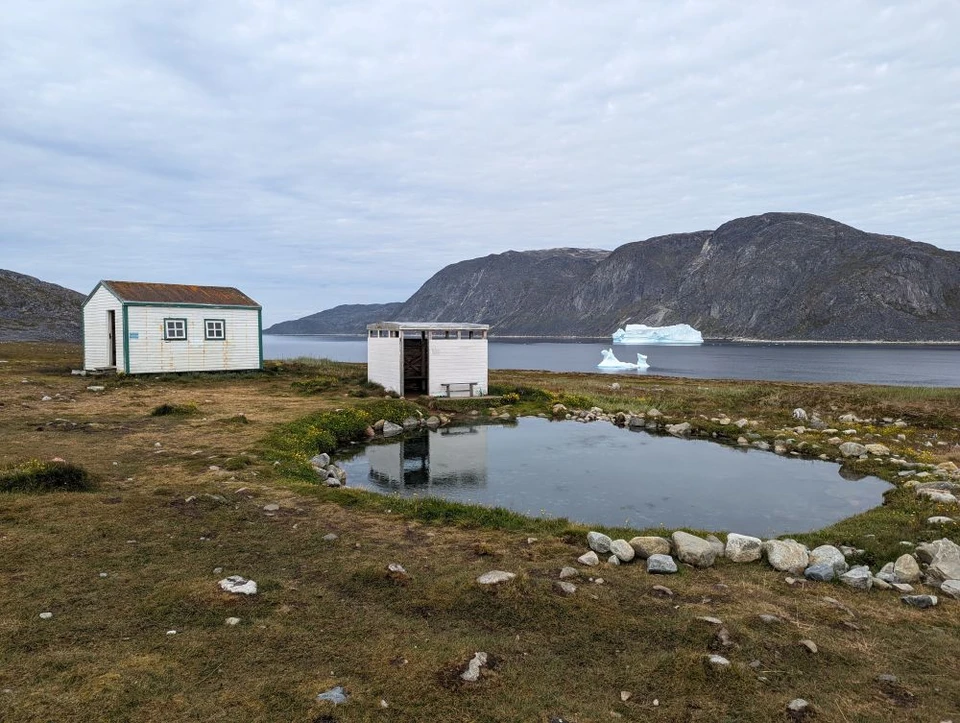
Uunartoq is one of Greenland’s best-known thermal springs, having been described in Icelandic texts as far back as the year 1300. The water maintains a pleasant temperature of around 38–40 degrees Celsius, and the spring forms natural pools where visitors can bathe. The area is a popular attraction for both locals and tourists seeking a unique experience in the Arctic landscape. Photo: Michael Kühl, Professor at the Department of Biology, University of Copenhagen.
382 springs – but far from a complete picture
In the scientific study Review of Greenland’s thermal springs, researchers and specialists from leading research institutions in Denmark, Greenland, Iceland and Sweden – including Geological Survey of Denmark and Greenland (GEUS), Greenland Institute of Natural Resources and University of Copenhagen – have compiled and reviewed the most comprehensive body of knowledge to date on Greenland’s thermal springs.
“We have compiled and quality-assured knowledge that has previously been scattered across more than 100 years of material – ranging from old expedition reports and botanical studies to modern satellite images and local place names such as ‘Uunartoq’ and ‘Puilasoq’, meaning ‘hot spring’ and ‘spring’. This gives us a completely new overview of where the springs are located and what we actually know about them,” says Eva Bendix Nielsen, a Postdoc at GEUS and lead author of the study.
The many springs cover a wide variety of environments. The hottest springs are found on Greenland’s east coast, where the water temperature can exceed 45 to 60 degrees Celsius. It is so hot that multicellular organisms cannot thrive, and the springs are therefore dominated by microorganisms that form colourful, centimetre-thick biofilms. The extreme conditions make them particularly interesting for research.
“These coloured biofilms are living communities of microorganisms that have adapted to extreme temperatures. They give us a unique insight into how life can exist under conditions reminiscent of those found in some of Earth’s earliest environments,” says Professor Michael Kühl from the University of Copenhagen, who researches biofilms and has contributed to the study with data and photographic documentation from several expeditions to the East Greenlandic springs.
As part of the work, the researchers have also developed an open database that brings together existing data in one place. The database is built, among other things, on data collected by the Greenland Institute of Natural Resources over the past decade and combines historical descriptions and place names with modern satellite data.
“The database expands our overview of known springs in Greenland – and there are surely many more out there that have yet to be discovered and mapped. Nevertheless, it provides a better basis for ensuring the conservation and consideration of these springs, for example when it comes to construction projects and mineral extraction work,” says Karl Brix Zinglersen, Head of the Department of Environment and Minerals at the Greenland Institute of Natural Resources.
The database currently contains information on 382 thermal springs spread across Greenland, but the mapping is far from complete. As early as August 2026, Michael Kühl and Eva Bendix Nielsen will set out in search of new thermal springs on Greenland’s east coast on an expedition funded by the Carlsberg Foundation.
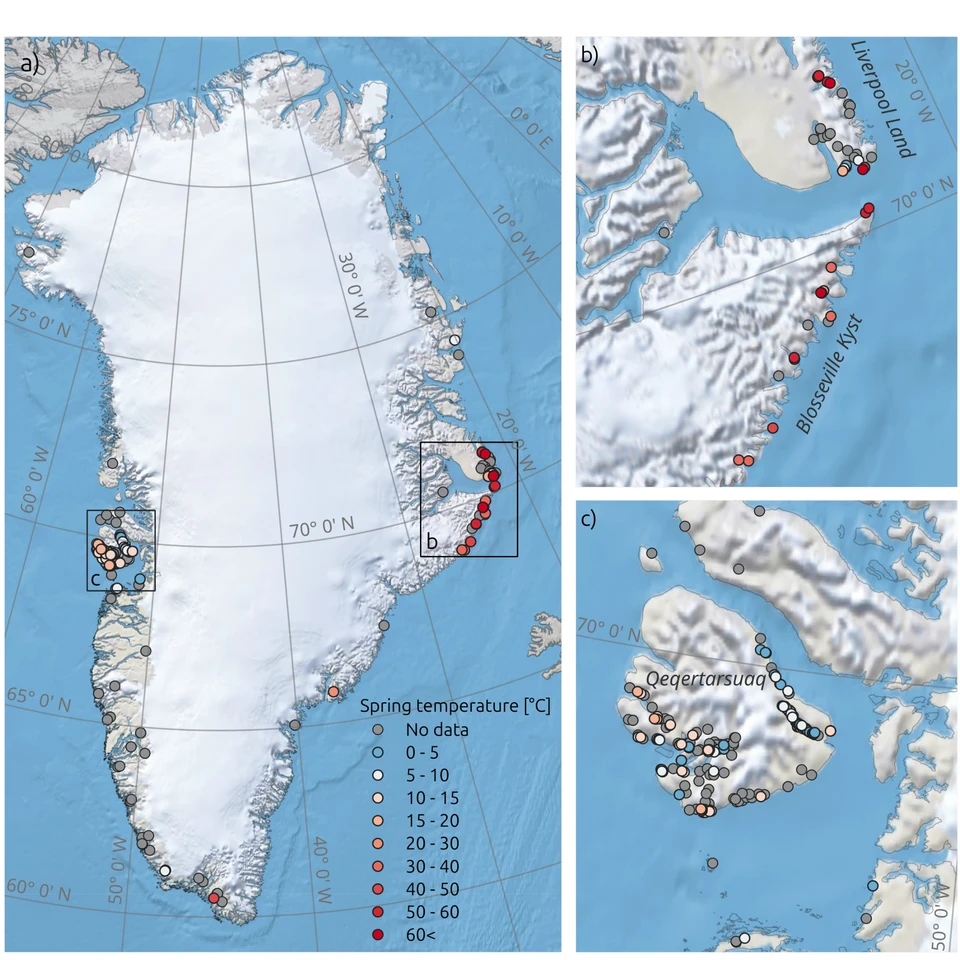
Map of thermal springs in Greenland indicating water temperature: (a) all of Greenland, (b) the Blosseville Coast and Liverpool Land in East Greenland, and (c) Qeqertarsuaq in West Greenland. Credit: Basemap from QGreenland with data from Moon, T.A., Fisher, M., Stafford, T. & Thurber, A. 2023.
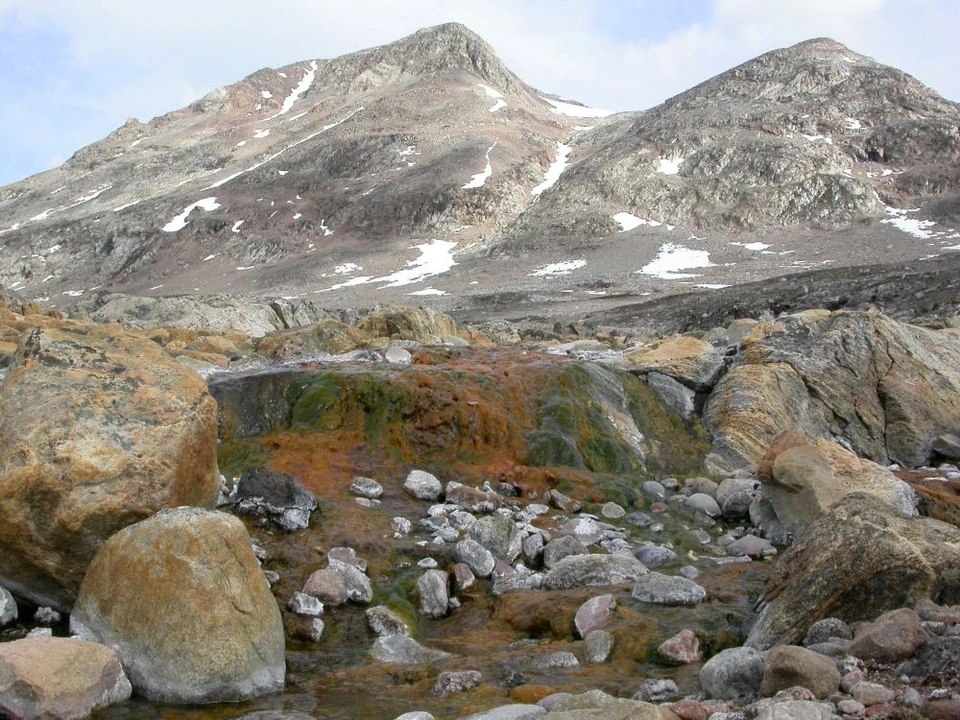
Centimetre-thick orange-green biofilms of microorganisms in a spring with a temperature of 50–55 degrees Celsius near Nørrefjord (Liverpool Land) on Greenland’s east coast, where the extreme water temperatures create unique living conditions. Photo: Michael Kühl, Professor at the Department of Biology, University of Copenhagen.
Researchers are calling for help from those who know the landscape
Many of Greenland’s thermal springs are located in areas rarely visited by researchers. As a result, there is still a lack of basic knowledge about several of them.
“We need to map these special places to better understand and protect them. But we still lack knowledge, and here we are hoping for help from Greenlanders,” says Eva Bendix Nielsen.
Locals, hunters and tour operators frequently travel through the countryside, and their observations can therefore make a real difference, as they can contribute everything from photographs and temperature readings to descriptions of vegetation and water flow. This is already reflected in the database, where several springs have been mapped using information from locals.
A living database
The database is not intended as a finished product, but as a dynamic resource that can be continuously updated. The aim is both to provide a comprehensive overview and to open up new knowledge – including on climate change, biodiversity and the potential for geothermal energy.
At the same time, it provides a better basis for protecting the springs, which are vulnerable to both human impact and climate change.
How you can help
Have you spotted a thermal spring that hasn’t been recorded? Or do you have data on a known spring? If so, you can help improve the mapping.
Read about the study here:
The research is supported by Independent Research Fund Denmark, the Carlsberg Foundation and the Leister Foundation. In addition, the Commission for Scientific Research in Greenland has contributed, whilst the University of Copenhagen has provided long-term support to the Arctic Station in Qeqertarsuaq.
Anja Fonseca
Head of Press and Communications
Press and Communication
Emailanfon@geus.dk
Phone+45 41239992