
Arsenic is used in modern technology in satellites, mobile phones and solar cells, among other things. It is included on the EU’s list of critical raw materials, partly because the current supply chain for arsenic is highly dependent on imports from China, where it is a byproduct of lead and cobalt mining.
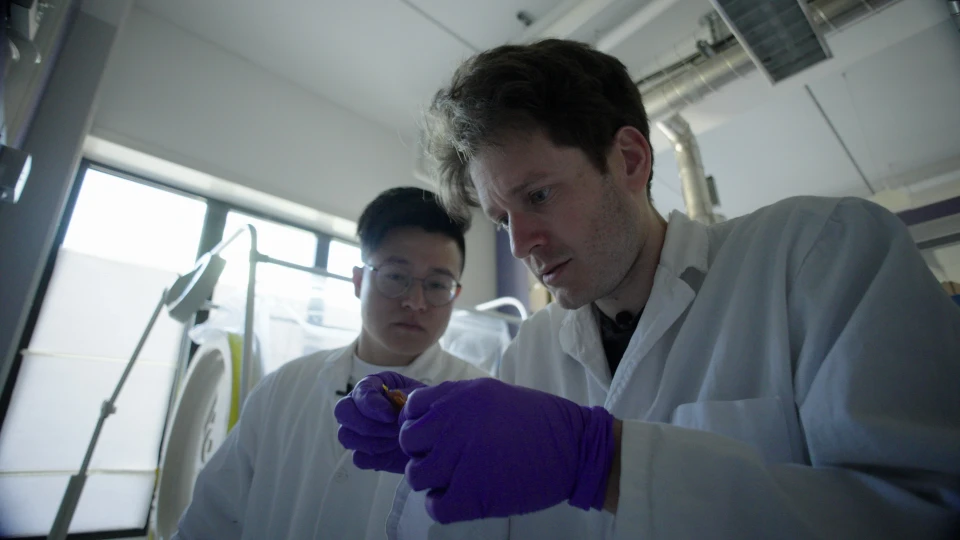
The fact that Case van Genuchten, senior researcher at the Geological Survey of Denmark and Greenland (GEUS), and postdoc Kaifeng Wang have managed to invent a process that enables them to extract arsenic from sludge from water treatment is a breakthrough in the recycling of critical raw materials.
“Of course, we weren’t sure that our method would work. That’s how it is in experimental research. To see it work in practice and to have amorphous arsenic that can now be tested for use in technology is absolutely fantastic,” says Case van Genuchten, senior researcher and author of the research article, which has just been published in Science Advances.
The method uniquely combines two procedures: water purification and chemical recovery of a critical raw material. The method has the potential to simultaneously contribute to increased use of water purification in areas of the world with harmful levels of arsenic in the water, solve challenges with sludge from water purification in many countries, and shift some of the value chains on which the EU’s green and digital ambitions depend.
When groundwater is purified so that it can be used as drinking water, it is because we want to fall below certain specified maximum contaminant levels (MCL) for certain substances. MCLs are often based partly on what is known about the health consequences, and therefore often also about the health economic consequences, of different occurrences, and partly on what is practically possible to purify and detect.
For arsenic, the MCL in Denmark is 5 micrograms per litre of water. Some countries have begun to implement a lower MCL, as this is linked to health economic gains. According to a report from the Danish Environmental Protection Agency from 2023, one of the barriers to lowering the MCL for arsenic in drinking water in Denmark is that we would be left with sludge with high concentrations of arsenic. There may be environmental challenges or regulatory obligations in connection with disposing of sludge with high concentrations of arsenic, which makes it difficult to handle.
Therefore, there is an advantage in being able to extract arsenic from the sludge and using it in technology instead. This would allow us to reap the health economic benefits of implementing new measures for purifying groundwater, thereby reducing the levels of arsenic in drinking water, while also making it easier to handle the sludge. In fact, sludge with high levels of arsenic may even become valuable, as arsenic is a critical raw material.
_GEUS.webp?width=960)
