
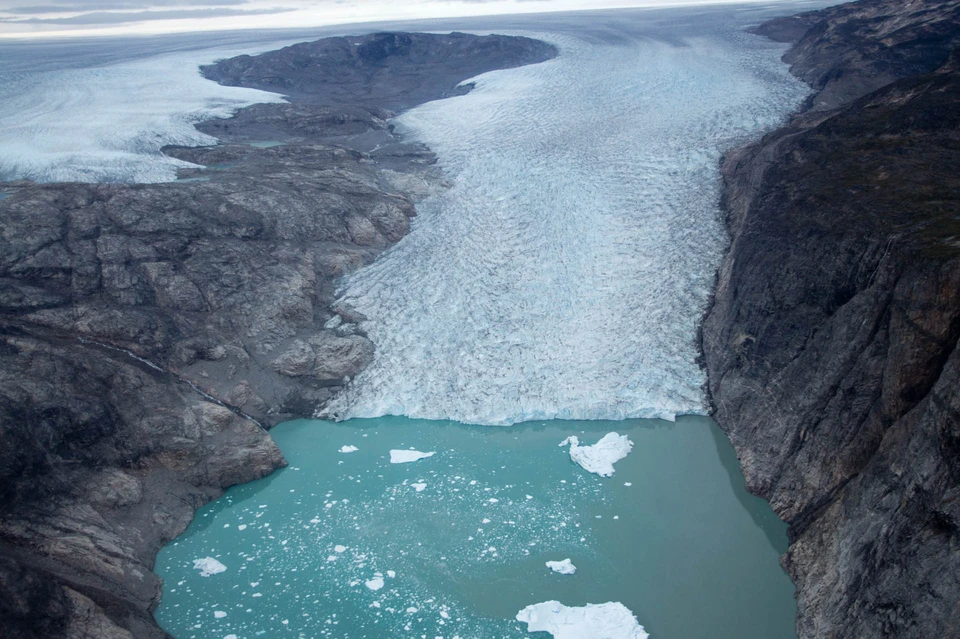
One step forward and two steps back, a slight shiver and a big crack – the glaciers of Greenland do a dance with steps often a mystery to science. But study by study, science is unlocking knowledge about these beautiful rivers of ice, allowing for increasingly accurate predictions of ice loss, sea level rise, marine temperature changes and nutrient flows. All things that follow, when fresh water is fed by the Greenland ice sheet into the surrounding oceans.
A new dataset published open access in Scientific Data presents new insights into the so-called frontal ablation of 49 of Greenland’s more than 200 tidewater glaciers – in other words, how much ice loss the glaciers that flows into the oceans and fjords experience at the front through melting at the surface, melting in the ocean and the break-off of icebergs.
“The novelty of the dataset is that it combines only observational data to derive frontal ablation compared to previous studies that contain some modelled components. This allows us to more accurately determine how much ice is lost, as we currently assume that all solid ice discharge is lost,” says Dominik Fahrner, Postdoc at the National Geological Survey of Denmark and Greenland (GEUS), and lead author of the paper.
Greenland’s tidewater glaciers have been contributing 30-60 % of the total annual mass loss from the Greenland Ice Sheet through ice loss at the front of the glaciers alone. Although the movements of the glacier’s fronts (called terminus) affect how much ice is lost, there are few in-situ measurements and most studies are limited to few geographical locations or include shorter time series, leaving much in the dark. But with the new dataset, the keyhole through which we may peek at the glacier’s dance has widened.
“This work has been a great collaborative effort that started as part of the Greenland Ice Sheet Ocean Science Network (GRISO), and we hope that the dataset and processing chain, which are both open source, will be valuable for the larger community,” says Dominik Fahrner.
The dataset provides three-monthly frontal ablation estimates for the 49 tidewater glaciers included based on solid ice discharge and glacier front position changes for each glacier. The results highlight that frontal ablation can differ significantly from solid ice discharge. On a seasonal basis, frontal ablation can exceed ice discharge by more than 50% at some glaciers during the summer retreat phase, but conversely ice discharge can exceed frontal ablation by a similar magnitude during winter advance. The study also supports previous results that solid ice discharge underestimates mass loss by ~4 %.
The dataset is relevant for scientists in their efforts to better understand processes that occur at the boundary between the ocean and the glacier, and to improve computer models that predict future ice loss and all the things that follow.
“The dataset is an important stepping stone. Now that we have accurate measurements of ice loss at the glacier front, we will investigate the relationship between ocean warming and ice loss in Greenland. This will, in the long run, allow us to reduce uncertainties in future predictions of sea level rise,” says Dominik Fahrner.

